Buyer's Guide · Updated October 2026
Buying in Todos Santos: the complete guide
How foreigners own property on the coast, what it costs to buy, own and sell, how residency works, and what to check before you sign — in Todos Santos, El Pescadero and Cerritos.
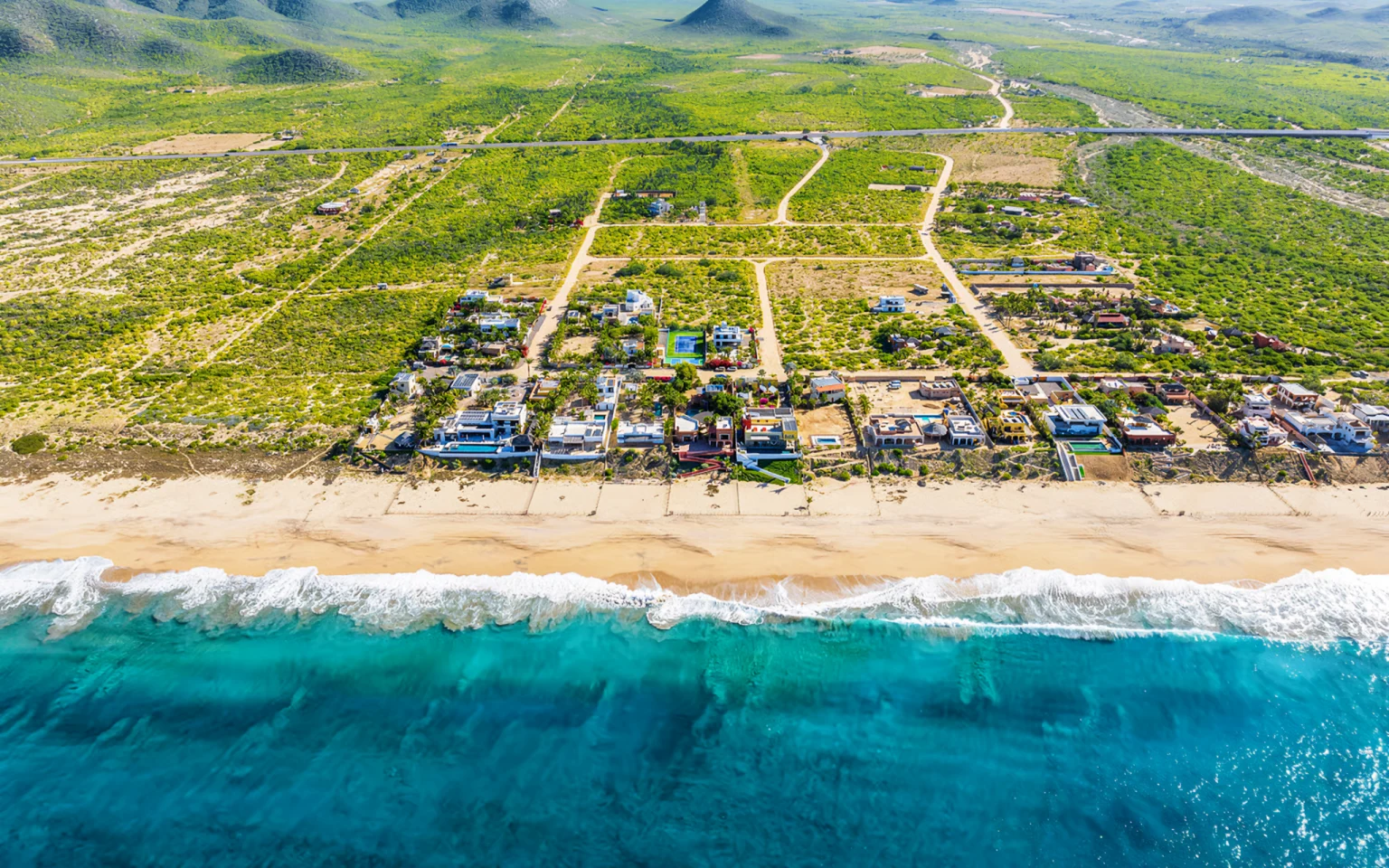
- Coastal ownership
- Bank trust · 50 years, renewable
- Acquisition tax (La Paz)
- 3% · since Jan 2026
- Buyer closing costs
- ≈ 5–8% of price
- Property tax
- 0.2–0.25% of cadastral value
- Offer to deed
- 45–90 business days
Contents
General information, not legal or tax advice. Figures checked October 3, 2026 against current law and official sources, listed at the end. Laws, fees and exchange rates change: confirm every number with a Mexican notary before you sign.
The short version
- Todos Santos, El Pescadero and Cerritos are inside Mexico's restricted zone, the 50 km strip along the coast. A foreigner cannot hold title there directly; a homebuyer holds it through a bank trust (fideicomiso) that lasts 50 years and can be extended.
- The three towns belong to the Municipality of La Paz. Since January 1, 2026, its acquisition tax is 3%. With notary, appraisal, registration, escrow and the trust, budget roughly 5 to 8% of the price on top of it.
- Pay through escrow or the notary, never directly to a seller or agent, and have the title, liens and land history checked before you sign.
- Owning is inexpensive: property tax is about 0.2 to 0.25% of the cadastral value a year, plus the trust fee and services.
- When you sell, a non-resident pays income tax of 25% of the price or 35% of the gain; a Mexican tax resident selling a home may be exempt up to 700,000 UDIs.
- To live here, a temporary or permanent residence visa starts at a Mexican consulate in your country.
Owning on the coast: the fideicomiso
Article 27 of the Constitution says foreigners may not own land directly within 100 km of the borders or 50 km of the coast. All of Todos Santos, El Pescadero and Cerritos is inside that strip. The Foreign Investment Law (articles 10 to 14) gives two ways to own anyway.
1. A bank trust, for a home
A Mexican bank holds title as trustee, with a permit from the Ministry of Foreign Affairs (SRE). You are the beneficiary, with the right to use and enjoy the property, rent it and keep the income, sell it, and name who inherits it. The trust lasts up to 50 years and can be extended at your request. When you sell, the buyer takes over your trust or opens a new one.
| Cost | Amount | Note |
|---|---|---|
| SRE permit | MXN 21,648.83 | One time. Ley Federal de Derechos, art. 25 (2026 text; updated yearly for inflation) |
| SRE application review | MXN 596.29 | One time |
| Bank setup | About US$500–4,000 | Banks do not publish fees; ask for written quotes |
| Bank annual fee | About US$400–800 | Every year while the trust exists |
The law gives SRE 5 business days (30 at its state offices) to answer. SRE has suspended that deadline while it repairs its online system, so permits are taking longer. In 2025 the trust business of CIBanco moved to Multiva after US Treasury action against CIBanco and Intercam: if you buy a property that is already in a trust, confirm which bank holds it today.
2. A Mexican company, for a business
A Mexican corporation with foreign shareholders can hold title directly, but only for non-residential use — rentals run as a business, a hotel, a development — and it must notify SRE. It costs more to keep each year (accounting and tax filings), so it is rarely the right choice for a home.
The purchase, step by step
- Offer and promise to purchase. Price, deposit, dates and conditions are set in a contrato de promesa de compraventa.
- Escrow. The deposit, usually 5 to 10%, goes into escrow. Title and escrow companies such as Secure Title Latin America, Fidelity National Title and Stewart Title work in Baja California Sur.
- Due diligence. Title, liens, land history, permits, water and access (see Before you sign).
- Trust permit and bank. The bank requests the SRE permit and runs its own know-your-client review.
- Appraisal. An appraiser authorized by the municipality values the property; the appraisal is valid for 90 days.
- Signing before the notary. The notario público is a senior lawyer appointed by the state who drafts the deed, checks the documents, calculates and collects the taxes, and pays them.
- Registration. The deed is recorded at the Public Registry in La Paz. The trust deed usually reaches you two to three months after closing.
From accepted offer to signing, plan on 45 to 90 business days.
Closing costs
The acquisition tax (Impuesto sobre Adquisición de Bienes Inmuebles, ISABI) is set by each municipality. Decree 3263, published in the state's Boletín Oficial No. 88 on December 24, 2025, raised it in La Paz from 2% to 3% from January 1, 2026. For a lot with a house used as a home, the 3% applies after deducting five times the annual UMA (about MXN 214,000 in 2026). The tax is charged on the highest of the contract price, the cadastral value and the appraisal. Many guides written before 2026 still say 2%.
| Item | Typical | Who sets it |
|---|---|---|
| Acquisition tax (ISABI) | 3% | Municipality of La Paz, by law |
| Notary fees | About 1–1.5% | The notary; no public schedule |
| Appraisal, registration, certificates | Varies | Municipal and state fees |
| Escrow | About US$1,000–3,500 | The escrow company |
| Trust permit and setup | See above | SRE and the bank |
| Total, usually | ≈ 5–8% of price | The notary gives the exact figure before closing |
Before you sign
- Title and liens. The current deed and a certificado de libertad de gravámenes from the Public Registry of Baja California Sur.
- Ejido history. Some land around Todos Santos was communal ejido land. It can be sold only after the ejido assembly granted full ownership (dominio pleno), the parcel left the National Agrarian Registry (RAN) and a title was recorded at the Public Registry (Ley Agraria, arts. 81–82). On the first sale after that, relatives, workers, ejidatarios and the ejido have a 30-day right of first refusal; a sale without that notice can be annulled (art. 84). Ask for a separate search at the RAN.
- Taxes and services paid. Receipts or certificates of no debt for property tax (predial) and water.
- Water. Municipal connection, a well with a CONAGUA concession, a shared well, or delivery by truck. Since the December 2025 reform of the National Waters Law, water concessions are no longer transferred with the property: CONAGUA reassigns them under a new title. Read our note on water in Todos Santos.
- Access. That the road to the property is a legal access, not a neighbour's courtesy.
- Beachfront. The first 20 m of firm land next to the beach is federal (ZOFEMAT). Using it — a deck, a palapa — needs a federal concession.
- Permits. Building licence and completion for any house; zoning for any lot (see Building).
- Money. Funds go to escrow or the notary, never directly to a seller or agent before closing.
What it costs to own
| Cost | Amount | Note |
|---|---|---|
| Property tax (predial) | 0.2% a year of the cadastral value for your own home; 0.25% for other uses | Ley de Hacienda de La Paz, art. 31. 10% discount for paying the year in January–February. Vacant urban lots pay more (1.1%, rising each year until built on) |
| Trust annual fee | About US$400–800 | The bank |
| HOA | Varies | Only in developments |
| Electricity (CFE) | Depends on use | Homes above the regional limit go to the high-consumption tariff (DAC); it takes 12 months below the limit to come back |
| Water | Municipal account, well fees or truck deliveries | Supply in La Paz municipality is scheduled, not continuous: houses have a cistern |
| Short-term rentals | 50% of the daily UMA per rental per day | New in 2026 (Decree 3263), including stays booked through apps |
As an example, a cadastral value of MXN 3,000,000 at 0.25% is MXN 7,500 a year. Cadastral values are usually below market value.
Selling later
- Non-resident seller (Ley del ISR, art. 160): income tax of 25% of the gross price, with no deductions, or 35% of the gain. When the sale is made by public deed, the 35% option does not require a legal representative in Mexico. The notary calculates and pays the tax.
- Mexican tax resident selling a home (art. 93): exempt up to 700,000 UDIs of the price (about MXN 6.2 million in October 2026), once every three years, if the sale is made before a notary.
- VAT: land and homes are exempt; the construction of a property not used as a home (a hotel, for instance) pays 16% VAT on the building portion.
Keep every invoice for improvements: with the gain-based option they reduce the tax.
Residency
- Visitor: up to 180 days per entry; the immigration officer decides how many.
- Temporary resident: 1 to 4 years, renewable within that period.
- Permanent resident: after four years as a temporary resident, or directly as a retiree with a pension.
The process starts at a Mexican consulate in your country. After entering Mexico you have 30 days to exchange the visa for a residence card at the National Migration Institute (INM). The law sets solvency in days of minimum wage (MXN 315.04 a day in 2026); each consulate publishes its own dollar figures. Examples for 2026:
| Temporary residence | Las Vegas consulate | New York consulate |
|---|---|---|
| Monthly income, last 6 months | US$4,630 | US$4,200 |
| Or average balance, last 12 months | US$78,025 | US$71,500 |
Owning property in Mexico worth more than 40,000 days of minimum wage (about MXN 12.6 million in 2026) also qualifies for temporary residence. For permanent residence as a pensioner, the law asks for a pension above 500 days of minimum wage a month (about MXN 157,500) or savings of 20,000 days; check your consulate's current figure. INM card fees in 2026: MXN 11,140.74 for one year of temporary residence, MXN 25,057.82 for four years, and MXN 13,578.96 for permanent residence.
Living here
- Distances. La Paz is about 80 km (1 h 15) and Cabo San Lucas about 75 km (1 h), both by highway 19; Los Cabos airport (SJD) is about 110 km via Cabo San Lucas (1 h 30), and La Paz airport about 90 km (1 h 15).
- Health. Todos Santos has a 24-hour public health centre. The nearest hospitals are in La Paz (private: Hospital Fidepaz; public: Hospital Juan María de Salvatierra and IMSS) and Los Cabos (private: H+ Los Cabos, among others). Residents can enrol in IMSS voluntarily (MXN 20,538.59 a year in 2026; some serious pre-existing conditions are excluded); most foreign residents also carry private insurance.
- Car. No temporary import permit is required while a foreign-plated car stays on the Baja California peninsula; it is required to take the car to mainland Mexico, including on the ferry from La Paz.
- Weather. Rain is rare most of the year; summer (July to September) is hot and humid, and September is the wettest month. The eastern Pacific hurricane season runs May 15 to November 30, most active from late August to September.
- Internet. Satellite internet (Starlink) works across the area; fixed-line service depends on the street — ask the seller what the house has.
- Cost of living. There is no reliable published index for Todos Santos. Budget for summer air conditioning, water storage, health insurance, the trust fee and property tax, and a car: most of life outside the centre is by road.
Building
- Construction licence. From the Municipality of La Paz, signed by an accredited professional, with property tax up to date. The fee is 0.7% of the construction value.
- Zoning. The urban development plan for Todos Santos–El Pescadero–Las Playitas (Boletín Oficial No. 40, 2012) sets densities and heights; for example, tourist-residential areas allow 4 homes per hectare on lots of at least 2,000 m², and buildings within 400 m of the coast are limited to two storeys (7.5 m). The municipality is preparing an update: confirm the current rules for your lot before you buy it.
- Historic centre. Work on or next to a catalogued historic monument needs a permit from INAH.
- Climate. Salt air and sun shape how a house should be built. Read building in a salt-air climate.
If you file taxes in the US
Real estate held directly or through a fideicomiso is not reported on the FBAR or Form 8938; Mexican bank accounts are, above the thresholds (FBAR: more than US$10,000 in total at any time of the year). Under Revenue Ruling 2013-14 the IRS does not treat a typical fideicomiso as a foreign trust, so Forms 3520 and 3520-A are generally not required. A company that holds the property is reportable. Ask your US tax adviser.
En corto
- Todos Santos, El Pescadero y Cerritos están dentro de la zona restringida, la franja de 50 km a lo largo de la costa. Un extranjero no puede tener ahí el título directo; quien compra una casa lo tiene a través de un fideicomiso bancario que dura 50 años y se puede prorrogar.
- Los tres pueblos pertenecen al Municipio de La Paz. Desde el 1 de enero de 2026 su impuesto de adquisición es de 3%. Con notaría, avalúo, registro, escrow y fideicomiso, calcula en total alrededor de 5 a 8% del precio.
- Paga a través de escrow o de la notaría, nunca directo al vendedor o a un agente, y revisa título, gravámenes e historia de la tierra antes de firmar.
- Mantener una propiedad cuesta poco: el predial es de 0.2 a 0.25% del valor catastral al año, más la cuota del fideicomiso y los servicios.
- Al vender, un no residente paga ISR de 25% del precio o 35% de la ganancia; un residente fiscal mexicano que vende su casa puede estar exento hasta 700,000 UDIs.
- Para vivir aquí, la visa de residente temporal o permanente empieza en un consulado de México en tu país.
Ser dueño en la costa: el fideicomiso
El artículo 27 de la Constitución dice que los extranjeros no pueden adquirir el dominio directo de tierras a menos de 100 km de las fronteras o 50 km de las costas. Todo Todos Santos, El Pescadero y Cerritos está dentro de esa franja. La Ley de Inversión Extranjera (artículos 10 a 14) da dos maneras de ser dueño de todos modos.
1. Un fideicomiso bancario, para una casa
Un banco mexicano tiene el título como fiduciario, con permiso de la Secretaría de Relaciones Exteriores (SRE). Tú eres el fideicomisario, con derecho a usar y disfrutar la propiedad, rentarla y quedarte con la renta, venderla y nombrar a quién la hereda. El fideicomiso dura hasta 50 años y se prorroga a tu solicitud. Al vender, el comprador recibe tu fideicomiso o abre uno nuevo.
| Costo | Monto | Nota |
|---|---|---|
| Permiso de la SRE | MXN 21,648.83 | Único. Ley Federal de Derechos, art. 25 (texto 2026; se actualiza cada año por inflación) |
| Estudio de la solicitud (SRE) | MXN 596.29 | Único |
| Apertura en el banco | Unos US$500–4,000 | Los bancos no publican tarifas; pide cotización por escrito |
| Cuota anual del banco | Unos US$400–800 | Cada año mientras exista el fideicomiso |
La ley da a la SRE 5 días hábiles (30 en sus delegaciones) para responder. La SRE suspendió ese plazo mientras repara su sistema en línea, así que los permisos tardan más. En 2025 el negocio fiduciario de CIBanco pasó a Multiva tras la acción del Tesoro de EE.UU. contra CIBanco e Intercam: si compras una propiedad que ya está en fideicomiso, confirma qué banco lo tiene hoy.
2. Una sociedad mexicana, para un negocio
Una sociedad mexicana con socios extranjeros puede tener el título directo, pero sólo para uso no residencial — rentas como negocio, un hotel, un desarrollo — y debe avisar a la SRE. Cuesta más mantenerla cada año (contabilidad y declaraciones), así que pocas veces es lo adecuado para una casa.
La compra, paso a paso
- Oferta y promesa de compraventa. Precio, depósito, fechas y condiciones quedan en un contrato de promesa de compraventa.
- Escrow. El depósito, normalmente de 5 a 10%, va a una cuenta de garantía. Empresas de título y escrow como Secure Title Latin America, Fidelity National Title y Stewart Title trabajan en Baja California Sur.
- Revisión (due diligence). Título, gravámenes, historia de la tierra, permisos, agua y acceso (ver Antes de firmar).
- Permiso y banco. El banco tramita el permiso de la SRE y hace su propia revisión de identidad del cliente.
- Avalúo. Un perito autorizado por el municipio valúa la propiedad; el avalúo vale 90 días.
- Firma ante notario. El notario público es un abogado nombrado por el estado que redacta la escritura, revisa los documentos, calcula y cobra los impuestos y los entera.
- Inscripción. La escritura se inscribe en el Registro Público en La Paz. El testimonio del fideicomiso suele llegar dos o tres meses después del cierre.
De la oferta aceptada a la firma, calcula 45 a 90 días hábiles.
Gastos de cierre
El Impuesto sobre Adquisición de Bienes Inmuebles (ISABI) lo fija cada municipio. El Decreto 3263, publicado en el Boletín Oficial del estado No. 88 el 24 de diciembre de 2025, lo subió en La Paz de 2% a 3% a partir del 1 de enero de 2026. Para un terreno con casa habitación, el 3% se aplica después de restar cinco veces la UMA anual (unos MXN 214,000 en 2026). El impuesto se calcula sobre el mayor entre el precio, el valor catastral y el avalúo. Muchas guías escritas antes de 2026 todavía dicen 2%.
| Concepto | Normalmente | Quién lo fija |
|---|---|---|
| ISABI | 3% | Municipio de La Paz, por ley |
| Honorarios del notario | Alrededor de 1–1.5% | El notario; no hay tabla pública |
| Avalúo, registro, certificados | Varía | Derechos municipales y estatales |
| Escrow | Unos US$1,000–3,500 | La empresa de escrow |
| Permiso y apertura del fideicomiso | Ver arriba | SRE y el banco |
| Total, normalmente | ≈ 5–8% del precio | El notario da la cifra exacta antes del cierre |
Antes de firmar
- Título y gravámenes. La escritura vigente y un certificado de libertad de gravámenes del Registro Público de Baja California Sur.
- Historia ejidal. Parte de la tierra alrededor de Todos Santos fue ejido. Sólo se puede vender cuando la asamblea otorgó el dominio pleno, la parcela salió del Registro Agrario Nacional (RAN) y el título se inscribió en el Registro Público (Ley Agraria, arts. 81–82). En la primera venta después, familiares, trabajadores, ejidatarios y el ejido tienen 30 días de derecho del tanto; una venta sin ese aviso se puede anular (art. 84). Pide una búsqueda aparte en el RAN.
- Impuestos y servicios pagados. Recibos o constancias de no adeudo de predial y agua.
- Agua. Toma municipal, pozo con concesión de CONAGUA, pozo compartido o pipa. Desde la reforma de diciembre de 2025 a la Ley de Aguas Nacionales, las concesiones ya no se transmiten con la propiedad: CONAGUA las reasigna con un título nuevo. Lee nuestra nota sobre el agua en Todos Santos.
- Acceso. Que el camino a la propiedad sea un acceso legal y no una cortesía del vecino.
- Frente de playa. Los primeros 20 m de tierra firme junto a la playa son federales (ZOFEMAT). Usarlos — una terraza, una palapa — requiere concesión federal.
- Permisos. Licencia de construcción y terminación de obra de cualquier casa; uso de suelo de cualquier lote (ver Construir).
- El dinero. Va a escrow o a la notaría, nunca directo al vendedor o a un agente antes del cierre.
Lo que cuesta ser dueño
| Costo | Monto | Nota |
|---|---|---|
| Predial | 0.2% anual del valor catastral para casa propia; 0.25% para otros usos | Ley de Hacienda de La Paz, art. 31. 10% de descuento pagando el año en enero–febrero. Los lotes urbanos baldíos pagan más (1.1%, que sube cada año hasta construir) |
| Cuota anual del fideicomiso | Unos US$400–800 | El banco |
| Cuota de mantenimiento | Varía | Sólo en desarrollos |
| Luz (CFE) | Según consumo | Las casas que rebasan el límite regional pasan a tarifa de alto consumo (DAC); se necesitan 12 meses debajo del límite para salir |
| Agua | Cuenta municipal, cuota del pozo o pipas | En el municipio de La Paz el agua llega por tandeo: las casas tienen cisterna |
| Renta vacacional | 50% de la UMA diaria por renta por día | Nuevo en 2026 (Decreto 3263), incluidas las estancias por plataformas |
Por ejemplo, un valor catastral de MXN 3,000,000 al 0.25% da MXN 7,500 al año. El valor catastral suele estar por debajo del valor de mercado.
Vender después
- Vendedor no residente (Ley del ISR, art. 160): ISR de 25% del precio total, sin deducciones, o 35% de la ganancia. Cuando la venta es por escritura pública, la opción de 35% no exige representante legal en México. El notario calcula y entera el impuesto.
- Residente fiscal mexicano que vende su casa (art. 93): exento hasta 700,000 UDIs del precio (unos MXN 6.2 millones en octubre de 2026), una vez cada tres años, si la venta se hace ante notario.
- IVA: el terreno y las casas habitación están exentos; la construcción de un inmueble que no es casa habitación (un hotel, por ejemplo) paga 16% de IVA sobre la parte de construcción.
Guarda cada factura de mejoras: con la opción sobre la ganancia reducen el impuesto.
Residencia
- Visitante: hasta 180 días por entrada; el agente migratorio decide cuántos.
- Residente temporal: de 1 a 4 años, renovable dentro de ese periodo.
- Residente permanente: después de cuatro años como residente temporal, o directamente como jubilado con pensión.
El trámite empieza en un consulado de México en tu país. Al entrar a México tienes 30 días para canjear la visa por la tarjeta de residente en el Instituto Nacional de Migración (INM). La ley fija la solvencia en días de salario mínimo (MXN 315.04 diarios en 2026); cada consulado publica sus cifras en dólares. Ejemplos 2026:
| Residencia temporal | Consulado en Las Vegas | Consulado en Nueva York |
|---|---|---|
| Ingreso mensual, últimos 6 meses | US$4,630 | US$4,200 |
| O saldo promedio, últimos 12 meses | US$78,025 | US$71,500 |
Ser dueño de un inmueble en México con valor mayor a 40,000 días de salario mínimo (unos MXN 12.6 millones en 2026) también califica para residencia temporal. Para residencia permanente como pensionado, la ley pide una pensión mayor a 500 días de salario mínimo al mes (unos MXN 157,500) o ahorros de 20,000 días; revisa la cifra vigente de tu consulado. Derechos de la tarjeta del INM en 2026: MXN 11,140.74 por un año de residencia temporal, MXN 25,057.82 por cuatro años y MXN 13,578.96 por la residencia permanente.
Vivir aquí
- Distancias. La Paz está a unos 80 km (1 h 15) y Cabo San Lucas a unos 75 km (1 h), los dos por la carretera 19; el aeropuerto de Los Cabos (SJD) está a unos 110 km pasando por Cabo San Lucas (1 h 30), y el aeropuerto de La Paz a unos 90 km (1 h 15).
- Salud. Todos Santos tiene un centro de salud público abierto las 24 horas. Los hospitales más cercanos están en La Paz (privado: Hospital Fidepaz; públicos: Hospital Juan María de Salvatierra e IMSS) y en Los Cabos (privado: H+ Los Cabos, entre otros). Los residentes pueden inscribirse voluntariamente al IMSS (MXN 20,538.59 al año en 2026; se excluyen algunas enfermedades graves preexistentes); la mayoría de los residentes extranjeros tiene además un seguro privado.
- Coche. Un coche con placas extranjeras no necesita permiso de importación temporal mientras se quede en la península de Baja California; sí lo necesita para cruzar a la parte continental, incluido el ferry desde La Paz.
- Clima. Llueve poco casi todo el año; el verano (julio a septiembre) es caluroso y húmedo, y septiembre es el mes más lluvioso. La temporada de huracanes del Pacífico oriental va del 15 de mayo al 30 de noviembre, con más actividad de finales de agosto a septiembre.
- Internet. El internet satelital (Starlink) funciona en toda la zona; el servicio fijo depende de la calle — pregunta al vendedor qué tiene la casa.
- Costo de vida. No hay un índice confiable publicado para Todos Santos. Presupuesta aire acondicionado en verano, almacenamiento de agua, seguro médico, la cuota del fideicomiso y el predial, y un coche: fuera del centro casi todo es por carretera.
Construir
- Licencia de construcción. Del Municipio de La Paz, firmada por un perito acreditado, con el predial al corriente. El derecho es de 0.7% del valor de la obra.
- Uso de suelo. El Programa de Desarrollo Urbano de Todos Santos–El Pescadero–Las Playitas (Boletín Oficial No. 40, 2012) fija densidades y alturas; por ejemplo, las zonas turístico-residenciales permiten 4 viviendas por hectárea en lotes de al menos 2,000 m², y a menos de 400 m de la costa se permiten dos niveles (7.5 m). El municipio prepara una actualización: confirma las reglas vigentes de tu lote antes de comprarlo.
- Centro histórico. Las obras en un monumento histórico catalogado o junto a él requieren permiso del INAH.
- Clima. La sal y el sol definen cómo debe construirse una casa. Lee construir en clima de aire salino.
Si declaras impuestos en EE.UU.
Un inmueble que tienes directamente o en fideicomiso no se reporta en el FBAR ni en el Form 8938; las cuentas en bancos mexicanos sí, por encima de los umbrales (FBAR: más de US$10,000 en total en cualquier momento del año). Según la Revenue Ruling 2013-14, el IRS no trata un fideicomiso típico como fideicomiso extranjero, así que en general no se requieren los Forms 3520 y 3520-A. Una sociedad dueña del inmueble sí se reporta. Consulta a tu asesor fiscal en EE.UU.
From the Journal
- The season ahead: October to December in Todos SantosCommunity & events · 2 min
- Buying in 2026: the acquisition tax in Todos Santos is now 3%Market insights · 2 min
- Residency in Mexico, 2026: what is asked, in numbersLiving here · 2 min
- Three festivals in three weeks: wellness, surf and cinemaCommunity & events · 2 min
- The season ends November 30: what to check on a house before you buyMarket insights · 2 min
- Healthcare near Todos Santos: clinics, hospitals and IMSSLiving here · 2 min
- December's finish lines: De Mar a Mar and GastroVinoCommunity & events · 2 min
- What can be built, and where: the Todos Santos urban planNew developments · 2 min
- Buying a lot with a well after the 2025 water reformBuying · 2 min
- How a fideicomiso works, in plain termsBuying · Legal · 9 min
- Building in a salt-air climateBuilding · 7 min
- Water in Todos Santos: the honest pictureTown · 8 min
Questions about a property?
TodosSantos.com answers every inquiry and helps you ask the right questions before you decide.
Todos Santos, Baja · Questions
Buyer’s Guide: questions
Can foreigners buy real estate in Todos Santos, Baja?
Yes. Todos Santos is in Mexico's restricted zone, so foreigners hold residential property through a bank trust (fideicomiso) or a Mexican company, with every right to use, rent, sell and inherit.
What are the closing costs in Todos Santos?
The acquisition tax is 3% since January 2026; with notary, appraisal, registration, escrow and the trust, total buyer costs land around 5 to 8% of the price.
What should I ask before the price?
Water: well, municipal connection, cistern or delivery. It changes what you can build and what the property is worth.